
Security Doesn’t Exist; Home Is Where the Danger Is
Nigeria’s security crisis has reached a stage where the ordinary meaning of safety has collapsed. Home no longer guarantees protection. Schools no longer guarantee learning. Roads no longer guarantee passage. Farms no longer guarantee livelihood. In many parts of the country, security is not absent because there are no uniforms, checkpoints or official statements. It is absent because the state’s presence has failed to translate into protection.
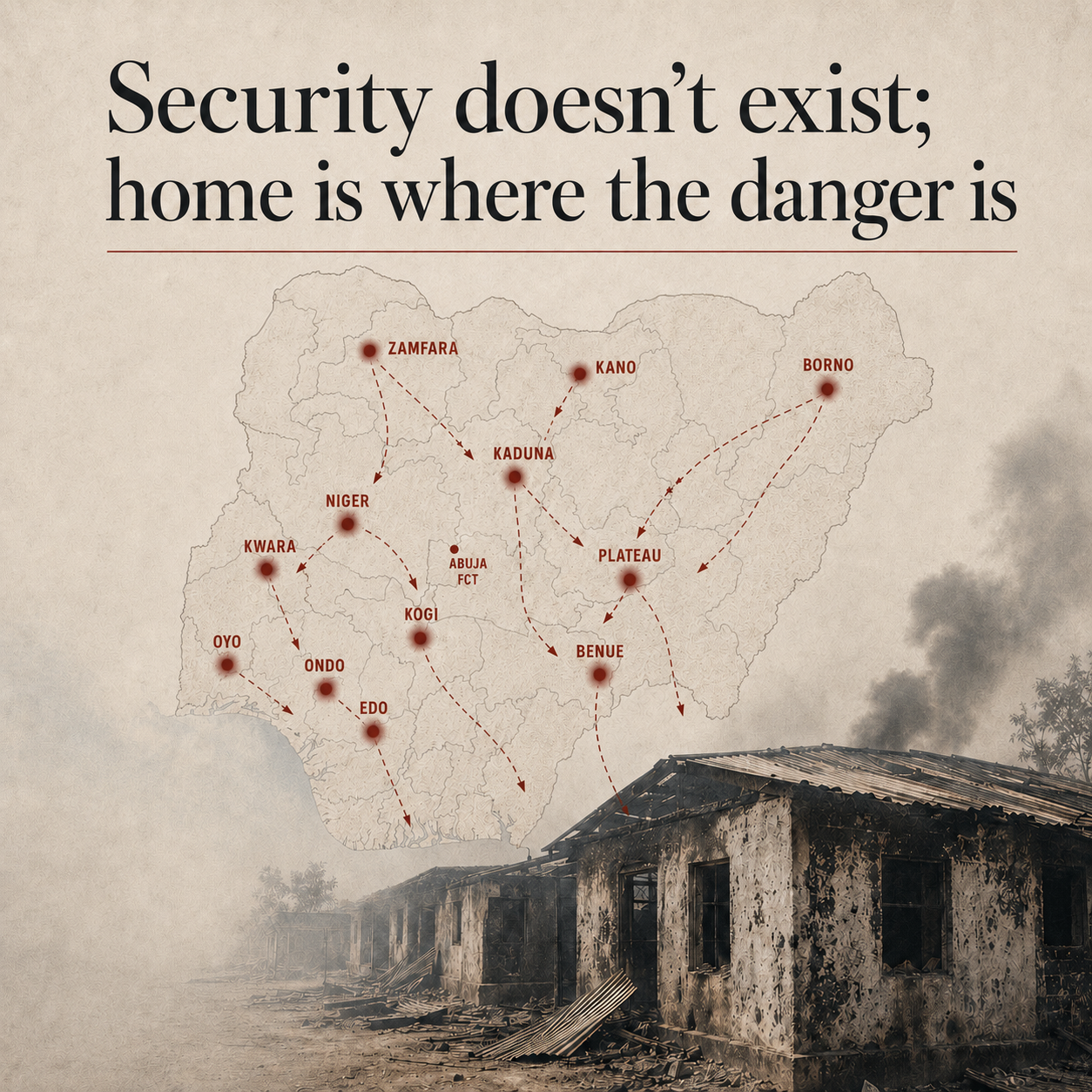
Nigeria’s security crisis has reached a stage where the ordinary meaning of safety has collapsed. Home no longer guarantees protection. Schools no longer guarantee learning. Roads no longer guarantee passage. Farms no longer guarantee livelihood. In many parts of the country, security is not absent because there are no uniforms, checkpoints or official statements. It is absent because the state’s presence has failed to translate into protection.
This is the central contradiction of Nigeria’s insecurity. Checkpoints are everywhere, yet kidnapping is routine. Security agencies announce operations, yet armed groups move entire communities through forests. Governments claim rescues, yet families often speak privately of ransom, negotiation and helpless waiting. The state is visible on the road but absent at the moment of danger.
The kidnapping economy has become one of the clearest signs of this failure. Mass abductions are no longer exceptional. They are now a tool of extortion, warfare and territorial control. Schoolchildren, farmers, travellers, priests, traders and villagers are taken because captivity has become profitable. Every successful ransom payment fuels the next operation.
The question Nigerians keep asking is brutally simple: how can hundreds of people be kidnapped and nobody knows where they went?
The answer is not that nobody knows. It is that Nigeria’s security system often lacks the intelligence, coordination and speed to turn information into rescue. Armed groups exploit forest corridors, rural settlements, informant networks and border routes beyond effective state control. Once victims disappear into difficult terrain, pursuit becomes slow and uncertain. Defence officials themselves have acknowledged problems ranging from poor intelligence and overstretched troops to misleading informants and the challenge of tracking kidnappers through forests.
But terrain alone cannot explain the scale of the crisis. The deeper problem is governance. Kidnapping thrives where state institutions are weak or absent. Police stations are ineffective, courts are distant, roads are poor and local economies are fragile. In that vacuum, armed groups become the authority—taxing, punishing, negotiating and enforcing power through violence. A checkpoint on the highway means little if the communities behind it have been abandoned.
That is why insecurity keeps spreading. What began as insurgency in the north-east and banditry in the north-west has expanded into the north-central region and increasingly further south. Criminal networks move through weakly governed spaces where security remains reactive rather than preventive. Violence spreads because the state has failed to make it costly.
Official narratives around rescues have also eroded public trust. Governments often present the release of victims as proof of operational success, yet families, negotiators and local intermediaries frequently describe ransom payments even when officials deny them. The issue is not that desperate families pay to save lives. It is that ransom has become the most dependable path to freedom.
That creates a dangerous incentive. If kidnappers expect payment and face little risk of arrest after releases, abduction becomes a sustainable business. When officials announce “rescues” without explaining whether perpetrators were captured, weapons seized or networks dismantled, the public gets ceremony instead of accountability.
Nigeria’s challenge is therefore larger than terrorism. It is an ecosystem of insecurity in which jihadist groups, bandits, communal militias, criminal gangs, illegal arms flows, weak policing and economic desperation reinforce one another. Whether driven by ideology or profit, the result is the same: fear, displacement and the erosion of normal life.
The failure of policing is central. Nigeria relies too heavily on the military for internal security. Soldiers can clear territory and raid camps, but they cannot replace local policing, intelligence-led investigations and community trust. A country cannot militarise its way out of every kidnapping crisis. It needs a security system that knows who lives in a community, who finances violence, who moves weapons and who negotiates ransom.
That architecture does not yet exist at the required scale.
The government must also confront uncomfortable questions about complicity. When attacks recur in known corridors, ransom negotiations move through traceable channels and bandit leaders operate openly, Nigerians naturally suspect that parts of the system know more than they admit. This does not mean every official is involved. It means the state has failed to demonstrate that it is not compromised.
The consequences are national. Insecurity is damaging agriculture, disrupting education, driving up food prices, discouraging investment and deepening social divisions. More fundamentally, it is reshaping how Nigerians understand citizenship. When survival depends on vigilantes, negotiations with bandits or raising ransom money, the social contract has fractured.
Nigeria does not need more performative checkpoints. It needs intelligence-led policing, accountable rescue operations, financial tracking of ransom networks, stronger rural security, prosecution of collaborators, effective border control, protection of schools and honest public communication. Above all, it needs a government willing to admit that insecurity is not under control simply because officials say it is.
Security does not exist when citizens are safe only after they pay. It does not exist when abductors profit from every attack. It does not exist when home becomes the place from which people are taken.
For Nigeria, the crisis is no longer only about defeating armed groups. It is about rebuilding state authority before fear becomes the country’s most powerful institution.